As specialists with our own dedicated fleet, E2G Logistics breaks down how choosing the right vehicle and loading method can significantly reduce your shipping costs between the UK and Ireland.
Understanding the Trailer Fleet
At E2G, we don't believe in "one size fits all." We match your cargo to the specific vehicle that ensures safety and cost-efficiency.
1. Versatile: Secure and Versatile
Its fully enclosed rigid structure provides maximum protection against the elements and theft.
Best for: cartons, pallets, and bulk goods, this versatile solution adapts to most scenarios, meeting diverse transport and handling requirements.
Note: Ensure pallets have a stable base for forklift entry to prevent damage during cross-channel transit.Curtain Trailer: The "Efficiency King"
2. Curtain Trailer: The "Efficiency King"
Featuring a rigid roof and solid front bulkhead with retractable side curtains, these allow for loading from three sides (back and both sides).
Best for: Oversized items, machinery, or non-standard shapes.
Note: Since sides are flexible, we recommend heavy-duty stretch wrapping and edge protectors to prevent cargo shift during ferry crossings.
3. Roller Floor Trailers: High-Speed Transit
Designed for the demands of air freight, these feature pneumatically operated roller tracks in the floor. Tons of cargo can be loaded or unloaded in minutes.
Best for: Unit Load Devices (ULDs), air-cargo pallets, and time-sensitive cross-border transfers.
Strategic Shipping: LTL vs. FTL
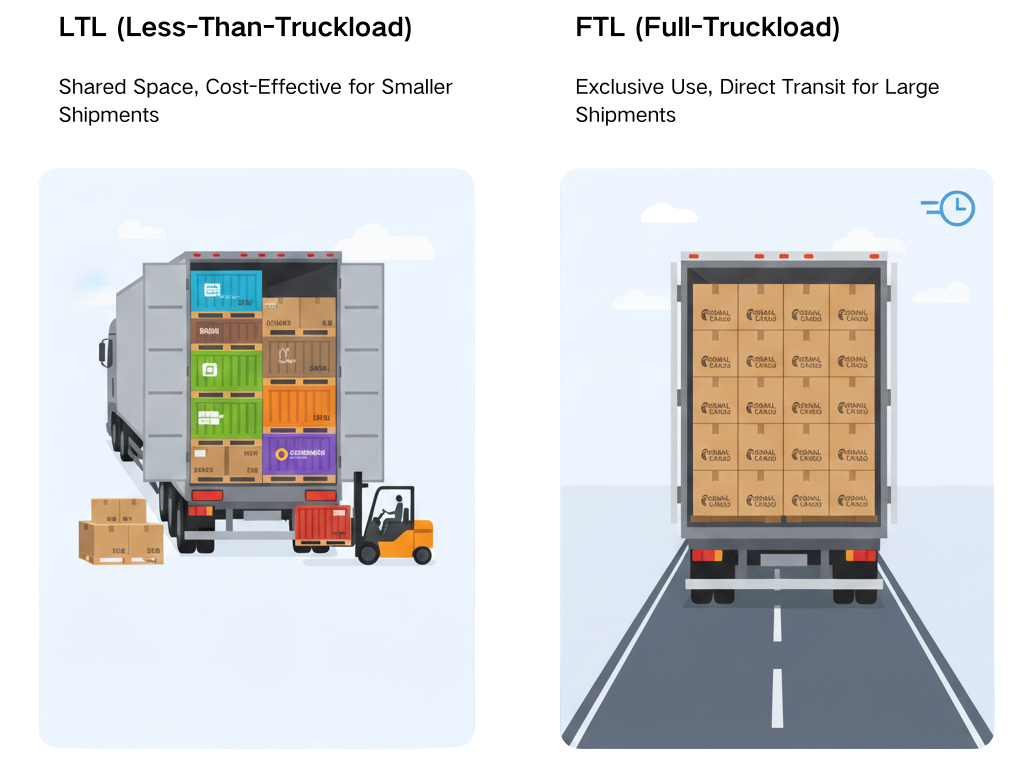
1. Less Than Truckload (LTL)
Your cargo shares space and costs with other shippers.
Pros: Highly cost-effective for smaller volumes; no need to wait for a full load to ship.
Cons: Longer transit times due to multiple stops and hub sorting.
2. Full Truckload (FTL)
You have exclusive use of the entire trailer, moving directly from origin to destination.
Pros: Fastest transit time; no intermediate handling.
Cons: Requires sufficient volume to justify the cost of the entire vehicle.
3. LTL vs FTL, how should I choose
For businesses requiring consistent Ireland-UK linehaul services, choosing between LTL and FTL is a critical decision.
Feature | LTL | FTL |
Cost | Lower. Pay only for the space you use. | Higher. But Cost-Per-Unit (CPU) drops with high volume. |
Speed | Slower. Involves hub-and-spoke sorting. | Rapid. Direct point-to-point delivery. |
Safety | Moderate. Multiple touches during transhipment. | High. Sealed at origin, opened at destination. |
Flexibility | Great for frequent, small replenishments. | Requires advanced inventory planning. |
Customs | Complex. Delays to one shipment can affect the truck. | Streamlined. Single declaration process. |
Professional Packaging Checklist
1. Standardised Pallets
Use UK Standard (1200x1000mm) or Euro Pallets (1200x800mm). Non-standard sizes lead to wasted space in LTL shipments and may incur "manual handling" surcharges.
2. Clear Label
Ensure every pallet has a clear label/packing list that matches your T1/T2 customs documents exactly. Organised labelling speeds up Irish Revenue and HMRC inspections.
3. Strapping & Edge Guards
For heavy loads, use tension strapping to secure cargo to the pallet base. This prevents "shunting" during the sea leg of the journey.
Why Choose E2G’s Own Fleet?
When you partner with E2G, you aren't just booking a truck; you are securing a controlled logistics environment.
Asset Ownership: We maintain and clean our own vehicles, ensuring your goods are never compromised by third-party equipment standards.
Agile Scheduling: Unlike brokers, we control the schedule. We can adjust loading plans based on your specific packaging needs and provide real-time guidance.
View our full range of Ireland-UK shipping services here.
Ready to reduce your UK-Ireland logistics costs by 10%?
Contact our logistics experts today for a free loading optimisation plan tailored to your cargo dimensions.